

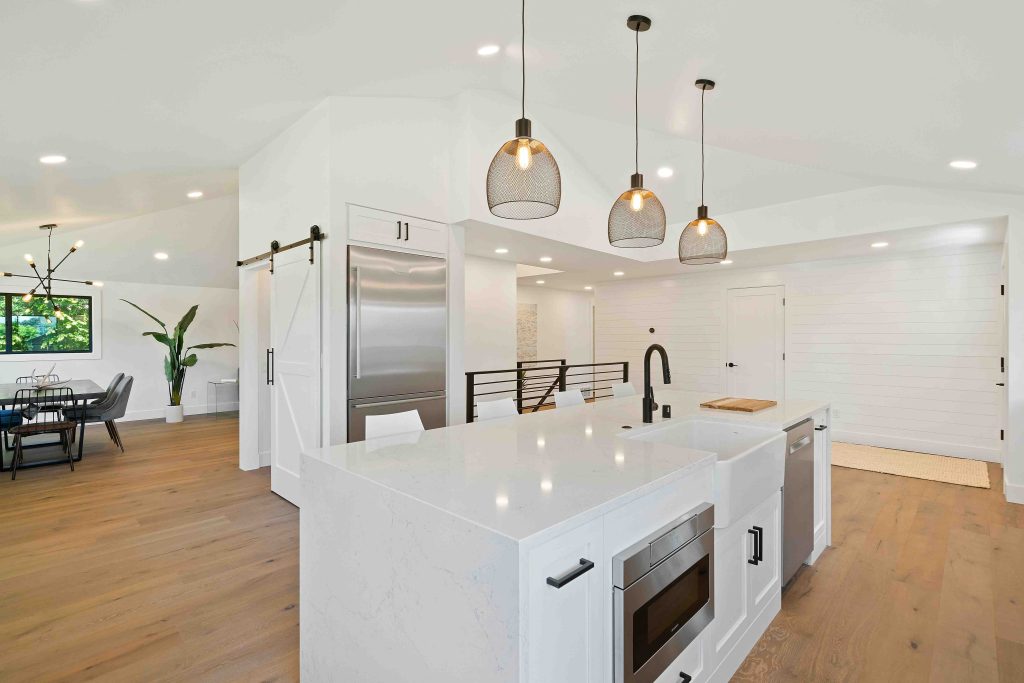
Your benchtop is the most used surface in your home. It’s where meals are prepared, homework is done, or where your guests linger when you’re entertaining. So, choosing your benchtop that suits you, your family, and your lifestyle can be pivotal for how you function in your home. Laminate, granite, engineered stone and acrylic are all great products for the right people. Where the “best” option really comes down to how you actually live in your kitchen, not just how it looks on the day it’s installed.
Laminate Benchtops
Laminate will give you the largest selection of colours and finishes, with the practicality, durability and economy that you need. If you’re renovating on a budget, building a rental, or want a benchtop that performs well without a premium price tag, laminate is hard to beat. Modern laminates have come a long way too; many now convincingly mimic the look of stone or timber, so you’re not sacrificing style for value.
Granite Benchtops
Granite offers beautiful colours, rich from nature, and is hardwearing and enduring; with many different pricing grades available depending on the stone you choose. As a natural igneous rock, no two granite slabs are ever quite the same, which is exactly the appeal for homeowners who want a genuinely one-of-a-kind kitchen feature.
Independent material comparisons back up granite’s reputation for toughness: it’s rated highly for resistance to extreme temperatures, impact and sunlight, and holds up to compressive loads better than most alternatives, with typical warranty periods of 10–20 years (Adjisaputri et al., 2020). The trade-off is that granite is heavier and takes longer to fabricate and install than engineered alternatives, and because slabs are jointed rather than seamless, you will see seam lines in larger installations.
Engineered Stone Benchtops
Resistant to stains, cracks, scratches, chemicals and heat, engineered stone is the perfect choice for a working kitchen. It gives you the consistency and durability of a manufactured, tested product, which is why it’s popular for busy households and kitchens. Because it’s non-porous, it’s easy to clean, ridding of all bacteria easily, without the need for sealing or resealing to stay that way. It also holds up to everyday acidity that would etch marble, so lemon juice, wine and vinegar splashes aren’t a concern. With such a wide range of colours and patterns available, it’s easy to get a bench that suits the design without the unpredictability of a natural slab, and because slabs are manufactured to spec, it’s simpler to achieve a seamless look across large islands.
Acrylic Benchtops
Acrylics are advanced, non-porous, highly versatile benchtops with seamless jointing, available in a wide variety of colours. Any scratches or chips can be repaired, meaning you end up with a long-lasting product that retains its good looks for years to come.
The seamless jointing and non-porous surface are genuine, measurable advantages over natural stone. A direct materials comparison found solid-surface acrylic outperforms granite on joint seams, surface porosity and bending strength, and is lighter and faster to install (Adjisaputri et al., 2020). The same study notes acrylic’s typical warranty sits a little lower, around 3-15 years compared to granite’s 10-20, and it’s not quite as tolerant of extreme heat, so it suits busy family kitchens beautifully, but isn’t the pick if you’re planning on resting hot pots straight off the stove.
So, Which One Suits Your Lifestyle?
- Busy household, renovating on a budget: Laminate gives you the widest colour choice and best value.
- Love natural stone character and don’t mind visible seams: Granite is a genuine investment piece.
- Want stone-like durability with consistent performance: Engineered stone, from a supplier who’s transparent about their formulation.
- Want a seamless look with easy repairs: Acrylic solid surface is built for that.
For your benefit, here is a comparison table that will help you determine which one best suits your lifestyle.
| Laminate | Granite | Engineered Stone | Acrylic | |
|---|---|---|---|---|
| Cost | Most budget-friendly | Mid–high, varies by grade | Mid–high | Mid-range |
| Look | Widest range of colours/finishes; can mimic stone or timber | Natural, one-of-a-kind pattern and colour | Consistent, engineered colour and pattern | Wide colour range, uniform finish |
| Joints | Visible seams | Visible seams | Visible seams (minimised by fabricator) | Seamless |
| Heat & scratch resistance | Good for everyday use, least resistant of the four | Highly resistant to heat, impact and sunlight1 | Stain, scratch, chemical and heat resistant | Non-porous; scratches and chips are repairable |
| Weight & install | Light, quick install | Heavy, longer fabrication and install time | Moderate | Lighter, faster install than stone1 |
| Typical warranty | Varies by manufacturer | 10–20 years1 | Varies by manufacturer | 3–15 years1 |
| Best for | Budget renovations, rentals | Homeowners who want natural character | Busy, hardworking kitchens | Seamless looks, easy repairs |
There’s no single “best” benchtop, only the best one for how your household actually uses its kitchen.
References
Adjisaputri, A. W., Dewi, O. C., Laksitoadi, B., & Widyarta, M. N. (2020). A comparison review: Engineered material solid-surface and granite. AIP Conference Proceedings, 2230, 040006. https://doi.org/10.1063/5.0006397
Ramkissoon, C., Gaskin, S., Song, Y., Pisaniello, D., & Zosky, G. R. (2024). From engineered stone slab to silicosis: A synthesis of exposure science and medical evidence. International Journal of Environmental Research and Public Health, 21(6), 683. https://doi.org/10.3390/ijerph21060683